


Physical Security & Smart City Connectivity
Fiber speed. Reliable, jam-proof links. Easy deployment in days.
Altowav’s 60 GHz wireless bridges give physical security integrators, enterprise security teams, and municipalities the performance and protection to connect cameras, access control systems, alarms, sensors, and other smart city infrastructure quickly and cost-effectively. Build private point-to-point and point-to-multipoint networks across campuses, parking lots, perimeters, streets, and public spaces.
- Reliability & continuous operation: Carrier-grade, IP67-sealed radios, GPS-synchronized TDMA scheduling, and redundant ring support keep cameras connected around the clock.
- High throughput & video quality: Carry dozens of 4K camera streams with up to 3.8 Gbps aggregate Layer 2 throughput at up to 400m and sub-1 ms latency.
- Low total cost of ownership: Mount on existing poles and streetlights, avoid trenching and carrier data subscriptions, and operate in license-free spectrum.
- Fast, easy deployment: Deploy in days with pre-paired kits and auto-aligning links online in minutes.
- Network security & jamming resilience: Wi-Fi and cellular jammers cannot disrupt 60 GHz links, and AES-128 encryption, enabled by default, protects traffic.
- Device connectivity & power: C423 client radios power up to two cameras or other edge devices through dual PoE outputs, within a 60W total budget.
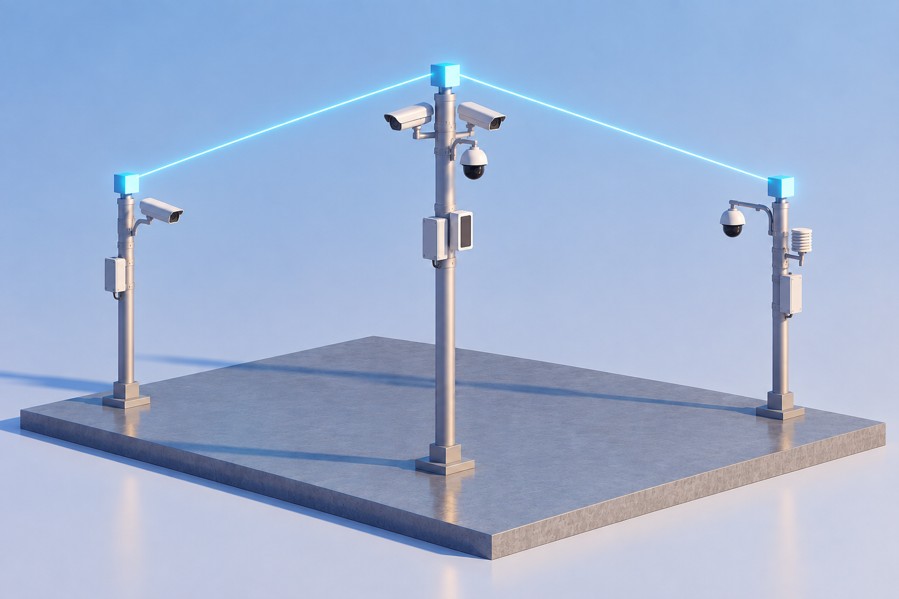
Physical Security & Smart City Connectivity Comparison Guide: 9 Key Factors
This Physical Security & Smart City Connectivity Comparison Guide evaluates Altowav 60 GHz wireless bridges, fiber, sub-6 GHz and CBRS networks, 4G/5G cellular, and copper Ethernet across nine deployment and operational factors.
Jump to: Reliability & Continuous Operation | High Throughput & Video Quality | Total Cost of Ownership | Fast, Easy Deployment | Network Security & Jamming Resilience | Topology Flexibility & Scalability | Device Connectivity & Power | Remote Monitoring & Management | Discreet Appearance & Minimal Footprint

1. Reliability & Continuous Operation
Reliability and continuous operation determine whether cameras, security systems, and smart city connectivity operates around the clock. Outages and unstable links can interrupt live monitoring, create gaps in centrally recorded video, and disrupt incident response and public safety operations. Connectivity built to withstand outdoor conditions, resist interference, and route around failed links minimizes downtime. Remote monitoring and troubleshooting speed issue resolution and reduce costly site visits.
Altowav. Altowav’s carrier-grade, U.S.-manufactured AltoPlex 60 GHz wireless bridges deliver continuous outdoor connectivity for cameras, security systems, and smart city infrastructure. Die-cast, powder-coated aluminum chassis with IP67 weather sealing withstand dust, moisture, and temperatures from −22°F to +131°F (−30°C to +55°C).
Adaptive beamforming and adaptive modulation maintain link stability as conditions change, while deterministic TDMA scheduling, GPS synchronization, and Golay codes sustain consistent performance in dense deployments. Distribution links can form redundant rings that reroute traffic if a link fails, preserving the path to monitoring centers. Integrators reduce site visits by remotely monitoring link health, troubleshooting issues, and managing radios through a web interface or open REST API.
Fiber. Properly installed fiber provides highly reliable connectivity, with light-based transmission immune to electromagnetic and radio-frequency interference. Its primary vulnerability is physical damage from excavation, construction, vandalism, and vehicle strikes on aerial lines. A single cut on a shared trunk can take multiple cameras or sensors offline. Remote monitoring can detect a fault, but repairing the break requires on-site crews with specialized equipment, with restoration time depending on the location and extent of the damage. Maintaining service through a cut requires a redundant, physically diverse path.
Other alternatives. Sub-6 GHz links can provide reliable connectivity; however, interference in crowded unlicensed bands can degrade or drop links in dense deployments. CBRS networks coordinate spectrum access, though General Authorized Access users can lose channels to higher-priority users. 4G/5G cellular benefits from carrier-managed infrastructure, but congestion can spike during emergencies and large events, and outages leave integrators dependent on the carrier to restore service. Copper Ethernet cabling is dependable within 328 ft (100m), although outdoor runs are exposed to physical damage and lightning surges, and each extender adds a potential point of failure.

2. High Throughput & Video Quality
Throughput determines how many cameras a network can support, and the video quality each can deliver, alongside other security and smart city connectivity traffic. Video quality also depends on sustaining that throughput: in dense deployments, interference can cause packet loss that degrades video even when capacity is available. Insufficient or unstable upstream bandwidth can force reductions in resolution, frame rates, or bitrates, or cause dropped frames and buffering, impairing live monitoring, identification of faces and license plates, and forensic review. As camera counts, resolutions, and analytics demands grow, capacity with headroom for peak traffic helps preserve video quality. Low, consistent latency supports responsive pan-tilt-zoom (PTZ) control, two-way intercom audio, and real-time alerts.
Altowav. AltoPlex 60 GHz wireless bridges deliver up to 3.8 Gbps aggregate Layer 2 throughput at up to 400m – carrying dozens of 4K camera streams, including video for license plate recognition and AI analytics systems, with headroom to add cameras and sensors over time. Narrow beamforming, deterministic TDMA scheduling, GPS synchronization, and Golay codes sustain throughput in dense deployments, and sub-1 ms link latency supports responsive PTZ control, intercom audio, and real-time alerts. Altowav achieves this performance on a single 60 GHz channel, leaving the other three channels available for neighboring links.
Fiber. Dedicated point-to-point fiber supports symmetrical link speeds from 1 Gbps to 100 Gbps or more and can provide sub-1 ms link latency across local distances. Optical signals are unaffected by RF interference, eliminating it as a source of video disruption. At camera locations, practical capacity is often set by the connected network equipment and can grow through equipment upgrades without replacing compatible cabling. In shared passive optical networks (PON), endpoints share upstream capacity, so video performance during peak periods depends on total network capacity, split ratios, and concurrent traffic.
Other alternatives. In point-to-multipoint deployments, sub-6 GHz and CBRS networks share sector capacity among connected endpoints, each of which may carry several cameras, and throughput can drop as interference and contention rise. 4G/5G cellular services generally provide much lower upload than download capacity, and camera video flows upstream. Congestion and plan-dependent data caps can further constrain continuous streaming. Copper Ethernet cabling supports 1 Gbps over Cat5e, or 10 Gbps over Cat6A, with low latency within 328 ft (100m), although some long-reach extenders reduce link speeds to extend distance.

3. Total Cost of Ownership
Total cost of ownership shapes an integrator’s ability to win bids and how much coverage an end customer can deploy and sustain within budget. Upfront costs for physical security & smart city connectivity include construction, equipment, power at each device location, and installation labor, while ongoing costs span spectrum and other recurring fees, maintenance, site visits, and network administration. Expansion adds to both, as each new camera location brings its own installation and operating costs. Lowering the cost per connected location leaves more budget for cameras, sensors, and analytics.
Altowav. Altowav lowers upfront and ongoing costs for camera and smart city networks. Radios mount on existing poles, streetlights, rooftops, and facades, avoiding trenching, boring, and right-of-way construction, while auto-alignment and pre-paired bridge kits reduce installation labor. The C423 client radio’s dual PoE outputs can power up to two cameras or other edge devices within its power budget, reducing the need for a separate PoE switch at each location. License-free 60 GHz operation eliminates spectrum licensing fees, and private links require no carrier data subscription. In point-to-multipoint deployments, each D621 distribution radio serves up to 15 clients, spreading infrastructure costs across multiple sites, and multi-gigabit capacity leaves headroom to add cameras over time. The equipment price includes full throughput, management, and REST API access, with no capacity licenses or controller subscriptions. Remote management through a web interface and automation through an open REST API reduce site visits and repetitive manual work.
4. Fast, Easy Deployment
Deployment speed and simplicity shorten delivery timelines, a key factor in winning competitive bids, and let integrators take on more projects with the same crews. Trenching, boring, and permitting can add weeks or months and disrupt streets, parking areas, and facility operations. At each location, power, mounting, alignment, and network configuration add labor. Across many sites, simplified link setup and a repeatable installation process reduce the need for specialized RF expertise and keep projects on schedule.
Altowav. Altowav enables camera and smart city connectivity deployments in days. Radios mount on existing poles, streetlights, rooftops, and facades, avoiding trenching, boring, right-of-way construction, and associated permitting delays. Pre-paired bridge kits arrive ready to install; once mounted, the phased-array antennas scan a 90° azimuth and 40° elevation sector to automatically find the paired radio, lock the link, and bring it online in minutes. The C423’s dual PoE outputs support up to two cameras within a 60W total budget. Native Layer 2 transparency lets installers easily add cameras to existing networks and VLANs, and REST API provisioning streamlines multi-site rollouts. Altowav also offers integrator training and certification, demo and evaluation units, and partner pricing.

5. Network Security & Jamming Resilience
Networks for physical security and smart city connectivity are targets in their own right. Intruders have used Wi-Fi jammers to disable wireless cameras and alarms, cutting off video and alerts when they matter most, and encryption alone cannot prevent that disruption. Operating frequency and beam directionality largely determine how easily a wireless connection can be jammed or intercepted. Encryption protects data in transit, while network segmentation keeps security traffic separate from other traffic on shared networks.
Altowav. Altowav’s 60 GHz connections operate in the 57–66 GHz band, far above the 2.4 GHz, 5 GHz, and cellular bands that Wi-Fi and cellular jammers target, so those jammers cannot disrupt them. Narrow beams also keep each signal tightly focused between radios, and natural oxygen absorption rapidly weakens it beyond the intended distance, giving Altowav bridges an inherently low probability of interception. AES-128 encryption, enabled by default with automatic secure key distribution, adds a second layer of protection for physical security and smart city traffic over these private wireless links. The 60 GHz wireless bridges support VLAN and QinQ so integrators can keep this traffic segmented on shared networks.

6. Topology Flexibility & Scalability
Topology flexibility determines how easily a network for physical security or smart city connectivity reaches cameras and sensors precisely where needed, with device locations often spanning gates, perimeters, parking lots, and intersections separated by obstructions. Scalable networks that combine backbone and distribution links, route around obstacles, and let integrators add devices incrementally support phased rollouts without costly redesign or disruption to existing surveillance.
Altowav. Each Altowav D621 distribution radio serves up to 15 client radios, with the option to link to another distribution radio, so one pole can anchor both a backbone link and a cluster of cameras, sensors, and access control devices. Distribution links can daisy-chain, branch, or form multi-hop paths around line-of-sight obstructions, extending coverage across parking lots, perimeters, campuses, and city streets from a single network connection. Each D621 covers a 90° sector, letting integrators aim coverage where cameras and sensors are located and add radios on the same pole to extend coverage in other directions, up to a full 360°. Integrators add camera locations incrementally by installing a client radio, without redesigning the existing network.
7. Device Connectivity & Power
How a connectivity option handles power and device connections governs how easily integrators can add cameras and other devices at each location. Most IP cameras draw power over PoE, but requirements vary widely: a fixed camera may need less than 15W, while PTZ cameras with heaters can require a PoE supply rated at 60W or more. Poles, gates, and rooftops often host several devices with limited power and mounting space, so port count and PoE capacity shape how much additional switching, power injection, and enclosures each site requires. Connected devices also need to join existing networks and VLANs without disrupting established addressing and segmentation.
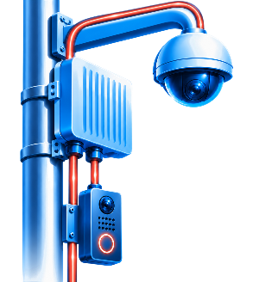
Altowav. The C423 client radio turns each camera pole, gate, or rooftop into a powered network edge. Its three gigabit Ethernet ports include one 90W PoE input and two PoE outputs that share 60W, with up to 60W available on a single port for high-power PTZ cameras. One PoE cable feeds the radio, which then powers and connects up to two devices on its output ports, such as cameras, access control readers, intercoms, Wi-Fi access points, or collocated Altowav radios that extend the network. Transparent Layer 2 bridging, with VLAN and QinQ support, connects these devices to existing networks without changing their IP configurations.
8. Remote Monitoring & Management
Physical security and smart city networks can span dozens or hundreds of locations, many on poles and rooftops where site visits can require a lift or bucket truck, and sometimes traffic control. Network equipment with open APIs allows integrators to centrally monitor link health from the management systems they already use and push configuration changes and firmware updates without visiting each site. When field work is necessary, quickly locating and accessing specific devices speeds on-site repairs, especially as deployments grow.
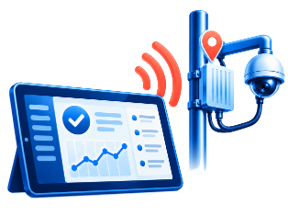
Altowav. Altowav gives integrators several ways to manage physical security and smart city networks: a web interface, CLI, SNMP v2 and syslog, and an open REST API. The REST API lets existing network management systems access link status and performance data, so radios can be monitored alongside cameras and other devices. Configuration changes and firmware updates can reach radios on poles and rooftops without dispatching a bucket truck, keeping firmware up to date and settings consistent across growing deployments. An integrated GPS receiver provides each radio’s location, making individual units easy to find across a campus or city. Technicians near the radio can access it through its built-in, management-only Wi-Fi interface from any phone or laptop browser, with no cable required.
9. Discreet Appearance & Minimal Footprint
Physical security and smart city connectivity equipment shares crowded poles, streetlights, and facades with cameras, lighting, and signage, often in highly visible public spaces. Larger enclosures, separate antennas, and extra equipment boxes add visual clutter, compete for space with cameras and sensors, and increase weight and wind load, while exposed cabling adds further clutter. Property owners and municipalities often review the size and appearance of attachments, so a smaller, cleaner installation can strengthen an integrator’s proposal as well as ease attachment approval.
Altowav. AltoPlex radios are compact enough to mount discreetly alongside cameras on poles, streetlights, and facades. Each radio’s antenna is integrated inside its enclosure, and the D621 measures just 5.9″ × 3.7″ × 1.4″ and weighs 14 oz, minimizing both visual impact and load on mounting structures. Even the three-port C423 is under 7″ square, and its PoE outputs reduce the equipment mounted at each site. Light-colored enclosures blend into many settings, and the small footprint can ease approvals for streetlight and pole attachments.
60 GHz Wireless Connectivity Technology Leader
Altowav is the 60 GHz wireless connectivity technology leader, focused exclusively on 60 GHz, with more than 100 customers using it’s solutions across last mile, campus, physical security, and smart city connectivity.
Production deployments. Altowav 60 GHz wireless bridges are in production at Sphere in Las Vegas, the East End District in Houston, Sedgwick County Zoo, and the Cities of Jacksonville, Arvada, and Sparks, and are deployed by integrators including Siemens, Bosch Building Technologies, Convergint, SECOM, and Teksys.
Case studies. In Houston’s East End District, Altowav 60 GHz wireless bridges connect analytics cameras, ALPR, and gunshot detection sensors across intersections with no existing backhaul and heavy RF congestion, helping identify a vandalism suspect within the first week of activation.
Distributors. AltoPlex 60 GHz wireless bridges, starter kits, and accessories are available through leading distributors, including ADI Global Distribution, Graybar, Wesco, and Winncom Technologies.
Physical Security & Smart City Case Studies
Integrators and municipalities deploy Altowav 60 GHz wireless bridges for video surveillance, analytics, and smart city connectivity.
East End District, Part I. In Houston, Teksys connected Bosch and Genetec analytics and ALPR cameras for the Road & Rail Safety Program across intersections with no existing backhaul, helping identify a vandalism suspect within the first week.
East End District, Part II. At Harrisburg Plaza, Teksys connected multi-sensor cameras and EAGL gunshot detection sensors through Genetec Security Center despite heavy RF congestion from METRO Light Rail and commercial traffic.
Sedgwick County Zoo. In Wichita, Sandifer Engineering & Controls connected ALPR and panoramic parking lot cameras plus food truck point-of-sale, saving more than $50,000 in boring and conduit costs.
Marksdale Gardens. In Boston, Electronic Security Group connected 20 Hanwha cameras across 43 video channels at a 178-unit, multi-building property, calling it one of the easiest wireless systems they had ever installed.